

AIPUXin: Your Professional Viscometer Supplier!
Shandong AIPUXin Automation Instrument Co., Ltd. specializes in the development, design, and production of intelligent automation sensors. As market demands change, our company has developed RF capacitive liquid level switches, magnetostrictive liquid level transmitters, RF capacitive liquid level transmitters, microwave material level switches, radar liquid level transmitters,viscosimeter, tuning fork density meter series products, etc. We have been working hard to create first-class products and become a first-class enterprise.
Our Advantages
Professional Production Equipment
Our modern factory is equipped with advanced CNC lathes, Mounters, oscilloscopes, sandblasting machines, argon arc welding machines, Ammeter, computer wire stripping machines, high-temperature test boxes, etc.
Continuous Product Innovation
Our company continues to innovate products, has more than 200 products, and has obtained more than 80 patents. CE certification, ISO9001, SIL certificates, etc., which enhance the credibility of our products and improve their competitiveness.
Strict Quality Inspection
Our R&D, design, and production strictly comply with international standards, and each process has strict operating procedures. More than 30 sets of testing and processing equipment help ensure product quality.
24-Hour Service System
The professional service team can quickly solve the problems users encounter and also provide customers with lifelong technical services. Video tracking services and emails make it easy for us to communicate with our customers on the fly.



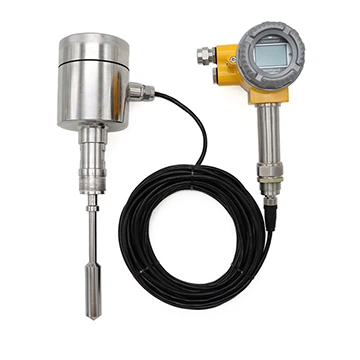


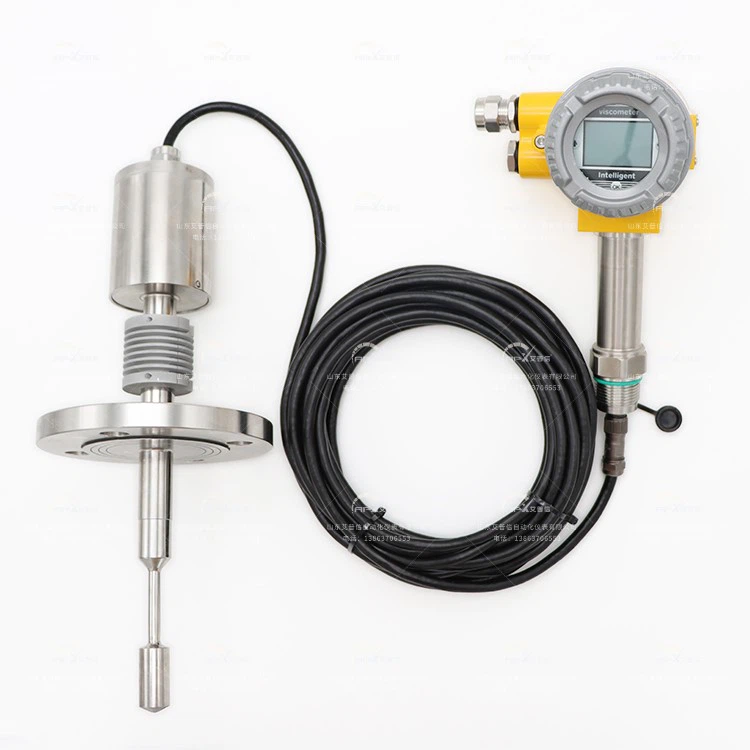
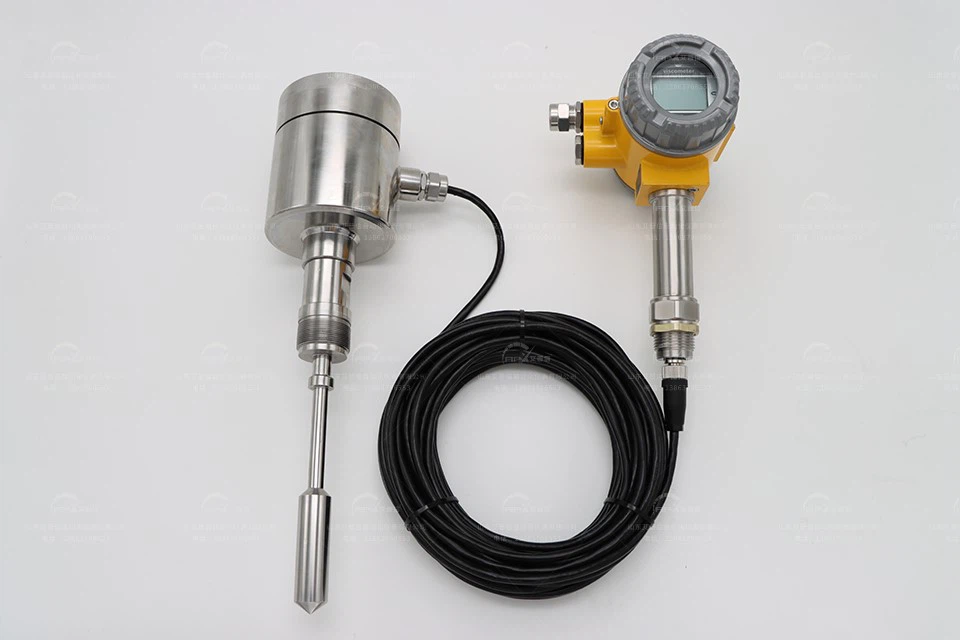
The In-line viscometer is a high-precision multi-indicator device that can measure the viscosity, density, and temperature of liquids in different environments. This instrument determines the viscosity of the liquid by detecting the vibration frequency and amplitude changes of the tuning fork and can provide reliable direct insertion measurements. The In-line tuning fork viscometer is widely used, including product testing, fuel mixing, and heating control.
Types Of Viscometer
Vibration viscometer
The vibration viscometer uses the physical phenomenon of an object vibrating in a liquid to measure the viscosity of a liquid. This type of viscometer usually has high sensitivity and can be used to measure the viscosity of various fluids, including low-viscosity liquids and high-viscosity pastes.
Typical applications:
Chemical industry (solvents, resins, coatings, etc.), petroleum industry (crude oil, lubricants, etc.), food industry (fruit juice, syrup, edible oil), pharmaceutical industry.
Tuning fork viscometer
Tuning fork viscometers are a branch of vibration viscometers that use a vibrating element similar to a tuning fork to sense the viscosity of a liquid. Tuning fork viscometers are commonly used for online monitoring of liquid viscosity in process processes.
Typical applications:
Petrochemical, food industry, pharmaceutical industry, paint and coatings, etc.
Slurry viscometer:
The slurry viscometer is a viscometer specially designed for measuring high-concentration and high-viscosity liquids. The slurry viscometer is suitable for measuring the viscosity of slurries containing solid particles, such as slurries, paints, jams, honey, etc.
Typical applications:
Mining (pulp), papermaking (pulp), and food processing.
Oil viscometer:
An oil viscometer is a viscometer designed for measuring the viscosity of oils and other lubricants. Oil viscometer is suitable for petroleum, chemical industry, energy, food, and other fields, and plays an important role in ensuring product quality and optimizing production processes.
Typical applications:
Petrochemical (lubricating oil, fuel oil), engine oil, lubricating grease, automotive manufacturing, edible oil, etc.
Advantages of Vibration viscometer
High accuracy
The accuracy of the vibration viscometer is ±1cP. It can provide very accurate measurement results and is especially suitable for research and quality control occasions that require high-precision viscosity data.
Fast response speed
The signal generated by the vibrating rod can quickly reflect changes in liquid viscosity, and the signal response time is only 2S, so it is very suitable for measuring dynamic viscosity or monitoring real-time changes in viscosity.
Wide measuring range
The vibration viscometer can measure a wide viscosity range of 0-109mPa·S. High-viscosity liquids (such as asphalt) can also be effectively measured.
Good stability
The vibrating rod continuously vibrates during the measurement process, which can reduce the adhesion of the measurement object on the vibrating rod, thereby improving the stability and accuracy of the measurement, and can operate stably in harsh industrial environments.
Customizable
According to different application requirements, the vibration viscometer can be customized with different parameter values to meet specific measurement requirements.
Simple installation and operation
It is easy to install, provides installation methods, simple and intuitive operation, and is easy to maintain and calibrate.
Application of Vibration viscometer

petrochemical industry
In the petroleum refining and chemical production process, viscosity is a key process parameter, which directly affects product quality and production efficiency. The vibration viscometer can monitor and control viscosity in real-time. By accurately controlling the viscosity during the production process, it can improve efficiency, reduce resource waste, and thereby reduce production costs.

Food Industry
The taste and texture of food largely depend on its vibration viscometer, which can reflect the proportion and stability of its ingredients. By using a vibration viscometer to monitor the viscosity of food, you can ensure that the taste and texture of the product meet standards and ensure the quality of the product. Overall quality.

Pharmaceutical Industry
In the development process of pharmaceutical preparations, vibration viscometer is an important factor affecting drug solubility, absorption rate, and bioavailability. It also has an important impact on mixing, dissolving, and injection operations during drug production and use. A vibration viscometer can be used to detect the viscosity of raw materials to ensure that they meet specified standards.

Paint and coating industry
The vibration viscometer of products such as paints and coatings directly affects key properties such as leveling, spreadability, and drying time. Through strict viscosity control using a vibration viscometer, you can ensure consistent product quality and performance.

Paper industry
A vibration viscometer is used in the papermaking process, such as sizing agents, fillers, and coatings. The viscosity of these additives needs to be strictly controlled to ensure that they can be evenly dispersed in the slurry. A vibration viscometer can provide accurate measurement data during this process, helping paper mills optimize the slurry ratio to obtain ideal paper properties.

lubricating oil
A vibration viscometer can monitor and control the viscosity of various oil products in real-time, helping workers on the production line to adjust formulas or process parameters promptly to ensure that products meet specified standards and specifications. This is crucial to ensure the performance and safety of the various types of oil used in cars.
The working principle of a vibratory viscometer is based on changes in resonant frequency. It uses a solid rod-shaped element that rotates and oscillates along its axial direction at a certain frequency when working. The sensor detects this frequency change and transmits the signal to the data analysis unit. The data analysis unit changes according to the resonance frequency of the vibrating element. to calculate the viscosity of the sample. Generally, the resonant frequency decreases in proportion to the increase in sample viscosity.
constant rate
The liquid flows at an applied shear rate and the resulting shear stress is measured. By changing the shear rate, the shear stress-shear rate curve of the liquid can be obtained, thereby obtaining the viscosity value.
Capillary
Based on the principle of Newtonian fluid flow in capillary tubes. When a liquid flows in a capillary tube, its flow rate is related to the pressure difference and the geometric size of the capillary tube, and is inversely proportional to the viscosity. By measuring the flow of liquid through a capillary tube under a certain pressure difference, the viscosity of a liquid can be calculated.
Resistance
When a liquid passes through a fixed obstacle, it will generate a certain resistance, which is proportional to the viscosity of the liquid. By measuring the resistance of a liquid, the viscosity of the liquid can be calculated
Certifications
3A certification, CE certification, ISO9001, SIL certificate, explosion-proof certificate, etc. prove our company's professional strength and the high quality of our products.


Our Factory
Our company was established on July 9, 2012, located in Huigu Phase 1, Zhongnan High tech Canal New City, Rencheng District, Jining City, Shandong Province. At present, we have a modern factory covering an area of 3000 square meters and equipped with professional production facilities. We have a team of dozens of R&D personnel dedicated to driving continuous innovation and optimization of our products.

Ultimate FAQ Guide to In-line Density Meter
Shandong Aipuxin Automation Instrument Co., Ltd. is one of the most professional in-line viscometer manufacturers and suppliers in China, specialized in providing high quality customized service. We warmly welcome you to wholesale cheap in-line viscometer in stock here from our factory. For price consultation, contact us.
in-line viscometer for canning lines, in line viscometer for weed control facilities, in line viscometer for agricultural systems