

What types of solids can Guided Wave Radar Level Meter measure?
Leave a message

As a reputable supplier of Guided Wave Radar Level Meters, I am often asked about the types of solids that our devices can effectively measure. Guided Wave Radar (GWR) technology has revolutionized the field of level measurement, offering reliable and accurate results across a wide range of applications. In this blog, I will delve into the various types of solids that can be measured by Guided Wave Radar Level Meters, exploring the unique characteristics and considerations for each.
Granular Solids
Granular solids are perhaps the most common type of solid material encountered in industrial applications. These materials consist of small, discrete particles that can flow freely or be packed together. Examples of granular solids include grains, sand, sugar, and plastic pellets. Guided Wave Radar Level Meters are well-suited for measuring the level of granular solids due to their ability to penetrate through the material and detect the surface accurately.
The key advantage of using a Guided Wave Radar Level Meter for granular solids is its immunity to dust and other environmental factors. Unlike traditional level measurement technologies, such as ultrasonic or laser sensors, GWR is not affected by dust clouds or moisture in the air. This makes it ideal for applications where the environment is dirty or challenging.
Another important consideration when measuring granular solids is the angle of repose. The angle of repose is the maximum angle at which a granular material can rest on a surface without sliding. When measuring the level of granular solids in a silo or tank, it is important to ensure that the GWR probe is installed at an appropriate angle to account for the angle of repose. This will ensure that the probe is able to detect the surface of the material accurately, even when the material is not perfectly level.
Powdery Solids
Powdery solids are similar to granular solids, but they consist of much smaller particles. Examples of powdery solids include flour, cement, and talc. Measuring the level of powdery solids can be more challenging than measuring granular solids due to their tendency to clump together and form bridges or rat-holes.
A Guided Wave Radar Level Meter can still be used to measure the level of powdery solids, but some additional considerations need to be taken into account. One of the main challenges with powdery solids is the formation of a static charge on the surface of the material. This static charge can interfere with the radar signal and cause inaccurate measurements. To overcome this issue, it may be necessary to use a special probe coating or grounding device to dissipate the static charge.
Another consideration when measuring powdery solids is the density of the material. Powdery solids can have a wide range of densities, which can affect the accuracy of the level measurement. It is important to ensure that the GWR probe is calibrated correctly for the specific density of the material being measured.
Lumpy Solids
Lumpy solids are materials that consist of larger, irregularly shaped particles. Examples of lumpy solids include coal, ore, and wood chips. Measuring the level of lumpy solids can be challenging due to their irregular shape and size.
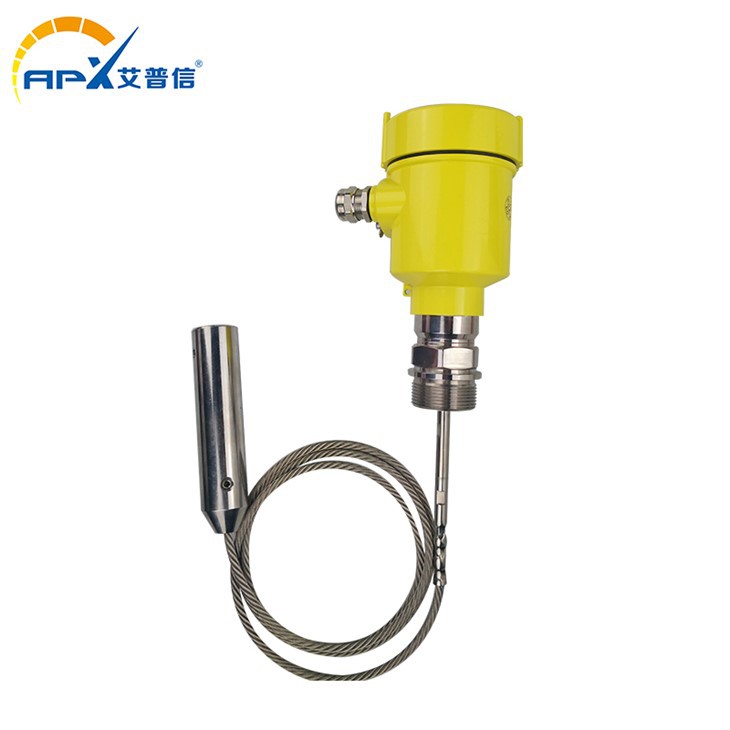
A Guided Wave Radar Level Meter can be used to measure the level of lumpy solids, but it is important to choose the right type of probe. For lumpy solids, a rod or cable probe is typically recommended, as these probes are more flexible and can conform to the irregular shape of the material. It is also important to ensure that the probe is installed at an appropriate angle to avoid getting blocked by the lumps.
In some cases, it may be necessary to use a multiple-probe system to accurately measure the level of lumpy solids. This involves installing multiple GWR probes at different locations in the silo or tank to provide a more comprehensive view of the material level.
Fibrous Solids
Fibrous solids are materials that consist of long, thin fibers. Examples of fibrous solids include cotton, wool, and paper. Measuring the level of fibrous solids can be challenging due to their tendency to entangle and form a dense mat.
A Guided Wave Radar Level Meter can be used to measure the level of fibrous solids, but it is important to choose the right type of probe. For fibrous solids, a rod or cable probe with a smooth surface is typically recommended, as this will help to prevent the fibers from getting caught on the probe. It is also important to ensure that the probe is installed at an appropriate angle to avoid getting clogged by the fibers.
In some cases, it may be necessary to use a special probe cleaning mechanism to keep the probe free of fibers. This can involve using a brush or air jet to remove any fibers that accumulate on the probe over time.
Special Considerations for Measuring Solids
In addition to the specific types of solids discussed above, there are some general considerations that need to be taken into account when using a Guided Wave Radar Level Meter to measure the level of solids.
One of the most important considerations is the temperature and pressure of the environment. Guided Wave Radar Level Meters are designed to operate within a certain temperature and pressure range, and it is important to ensure that the device is suitable for the specific application. For high-temperature applications, a 304 stainless steel pole antenna guided wave radar level gauge may be required to withstand the heat.
Another important consideration is the dielectric constant of the material being measured. The dielectric constant is a measure of how easily a material can be polarized by an electric field. Different materials have different dielectric constants, and this can affect the accuracy of the level measurement. It is important to ensure that the GWR probe is calibrated correctly for the specific dielectric constant of the material being measured.
Finally, it is important to ensure that the GWR probe is installed correctly. This involves choosing the right location for the probe, ensuring that it is installed at the correct angle, and making sure that it is properly grounded. Incorrect installation can lead to inaccurate measurements or even damage to the device.
Conclusion
In conclusion, Guided Wave Radar Level Meters are a versatile and reliable solution for measuring the level of a wide range of solids. Whether you are dealing with granular solids, powdery solids, lumpy solids, or fibrous solids, there is a GWR solution that can meet your needs. By understanding the unique characteristics and considerations of each type of solid, you can choose the right Guided Wave Radar Level Meter for your application and ensure accurate and reliable level measurements.
If you are interested in learning more about our Guided wave radar or Guided Wave Radar Level Transmitter products and how they can be used to measure the level of solids in your application, please do not hesitate to contact us. Our team of experts is ready to help you find the right solution for your needs and answer any questions you may have.

References
- Patan, R., & Zolich, R. (2017). Level Measurement Techniques: A Review. Sensors, 17(11), 2555.
- Liu, Z., & Yang, Y. (2018). Guided-wave radar level measurement technology: principles, applications, and challenges. Journal of Petroleum Science and Engineering, 163, 728 - 734.
- Singh, A., & Thakur, N. (2019). A review on level measurement techniques for liquids and solids in industrial applications. Measurement, 138, 1 - 11.





