

Can Guided Wave Radar Level Meter measure the level of slurries?
Leave a message

Can Guided Wave Radar Level Meter measure the level of slurries?
Hey there! I'm a supplier of Guided Wave Radar Level Meters, and today I want to dig into the question: Can Guided Wave Radar Level Meters measure the level of slurries?
First off, let's quickly go over what a Guided Wave Radar Level Meter is. A Guided Wave Radar (GWR) Guided wave radar works by sending electromagnetic pulses along a probe. When these pulses hit the surface of the material being measured, part of the energy is reflected back to the sensor. By measuring the time it takes for the reflection to return, the level of the material can be accurately determined.
Now, slurries are a bit of a special case. A slurry is a mixture of a solid and a liquid, kind of like a thick, soupy substance. Think of things like mining slurries, which can have solid particles suspended in water or other liquids. Measuring the level of slurries is tricky because of their unique properties.
One of the main challenges with slurries is their viscosity. Slurries can be very thick and sticky, which might cause issues for some level measurement technologies. But Guided Wave Radar Level Meters are pretty good at handling this. The probe of the GWR is in direct contact with the slurry, so it can still detect the level even when the material is thick. The electromagnetic pulses travel along the probe and are reflected off the surface of the slurry, regardless of its viscosity.
Another aspect is the presence of solids in the slurry. Sometimes, the solid particles can settle at the bottom or cause uneven surfaces. However, GWR is quite robust in this regard. It can still pick up the reflection from the overall surface of the slurry, even if there are some variations due to the solids. The technology is designed to filter out some of the noise caused by the solid particles and focus on the main reflection that indicates the level.
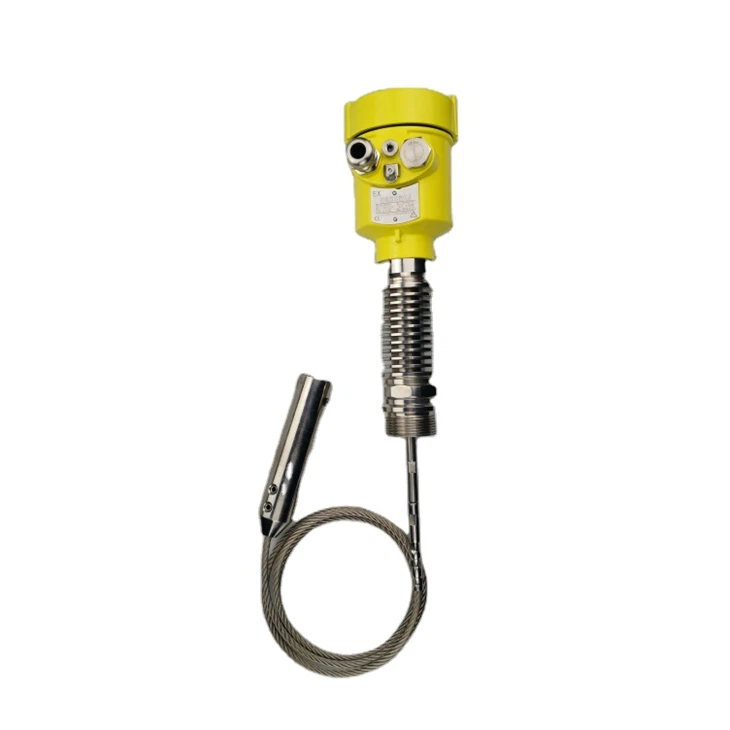

There are different types of Guided Wave Radar Level Meters that can be used for slurry measurement. For example, a Radar type level transmitter Radar type level transmitter can be a great option. Cable-type GWRs are flexible and can be installed in various tank sizes and shapes. They can handle the movement and flow of the slurry better than some other types of probes.
A 304 stainless steel pole antenna guided wave radar level gauge 304 stainless steel pole antenna guided wave radar level gauge is also a good choice. The stainless - steel construction makes it resistant to corrosion, which is important when dealing with slurries that might be acidic or contain chemicals. This type of gauge can be used in high - temperature applications as well, which is often the case in industrial processes involving slurries.
But it's not all smooth sailing. There are still some limitations. For instance, if the slurry has a very high concentration of solids, it might cause excessive buildup on the probe. This buildup can affect the accuracy of the measurement over time. Regular maintenance, like cleaning the probe, is necessary to keep the GWR working properly.
Also, if the slurry has a very low dielectric constant, it can make it harder for the radar pulses to detect the surface accurately. The dielectric constant is a measure of how well a material can store electrical energy, and a low value means the reflection of the radar pulses might be weaker. However, modern GWRs are designed with advanced signal processing algorithms to overcome these challenges to a certain extent.
In real - world applications, Guided Wave Radar Level Meters have been used successfully in many industries. In the mining industry, they are used to measure the level of ore slurries in storage tanks. In the food and beverage industry, they can measure the level of slurries like fruit pulp. In the chemical industry, they are used for measuring the level of various chemical slurries.
So, to answer the question, yes, Guided Wave Radar Level Meters can measure the level of slurries. They offer a reliable and accurate solution for this challenging task, especially when the right type of GWR is selected and proper maintenance is carried out.
If you're in an industry that deals with slurries and you're looking for a reliable level measurement solution, I'd highly recommend considering a Guided Wave Radar Level Meter. We, as a supplier, have a wide range of products to meet your specific needs. Whether you need a cable - type transmitter or a stainless - steel pole antenna gauge, we've got you covered.
If you're interested in learning more about our Guided Wave Radar Level Meters or want to discuss your specific application, feel free to reach out. We can provide more detailed information, product specifications, and even arrange a demonstration if needed. Let's have a chat and see how we can help you with your slurry level measurement requirements.
References
- Industry reports on level measurement technologies
- Technical manuals of Guided Wave Radar Level Meters





