
How do capacitive level sensors perform in a turbulent liquid environment?
Leave a message

Hey there! As a supplier of Capacitive Level Sensors, I often get asked about how these nifty devices perform in a turbulent liquid environment. So, let's dive right in and explore this topic.
First off, let's understand what capacitive level sensors are. These sensors work based on the principle of capacitance. Capacitance is the ability of a system to store an electric charge. In a capacitive level sensor, the liquid in the tank acts as one plate of a capacitor, and the sensor probe acts as the other. As the level of the liquid changes, the capacitance between the probe and the liquid changes too, and this change is measured and converted into a level reading.
Now, when it comes to a turbulent liquid environment, things get a bit tricky. Turbulence in a liquid can be caused by various factors such as agitation, pumping, or the flow of the liquid into or out of the tank. This turbulence can lead to fluctuations in the liquid level, splashing, and the formation of waves.
One of the main challenges that capacitive level sensors face in a turbulent environment is the inaccurate measurement of the liquid level. The splashing and waves can cause the sensor to detect the liquid at different points, leading to inconsistent readings. For example, if there are large waves in the tank, the sensor might detect the peaks of the waves as the liquid level, giving a higher reading than the actual average level.
However, modern capacitive level sensors are designed to handle these challenges to a certain extent. Many sensors come with advanced signal processing algorithms that can filter out the noise caused by turbulence. These algorithms analyze the signals received from the sensor over a period of time and can distinguish between the actual liquid level and the fluctuations caused by turbulence.
Another feature that helps capacitive level sensors in turbulent environments is the use of shielded probes. A shielded probe has an outer layer that protects the sensing element from the direct impact of splashing and waves. This outer layer acts as a barrier, reducing the interference caused by the turbulent liquid and allowing the sensor to get a more accurate reading of the liquid level.
Let's take a look at some of the specific types of capacitive level sensors and how they perform in turbulent conditions.
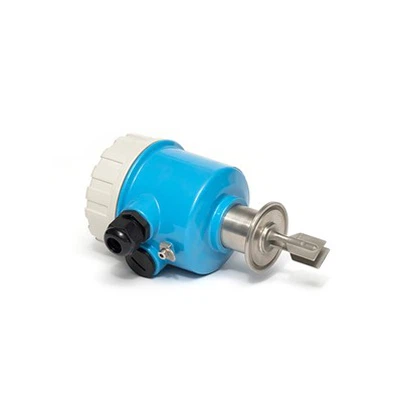
The Capacitive Level Gauge is a popular type of capacitive level sensor. It is known for its simplicity and reliability. In a turbulent environment, the Capacitive Level Gauge can still provide relatively accurate readings if it is properly installed and calibrated. The key is to place the gauge in a location where the turbulence is minimized, such as away from the inlet or outlet of the tank.


The Chinese factory manufacturing capacitor level gauge offers a cost - effective solution for level measurement. These gauges are often designed with features that make them suitable for turbulent environments. For example, they may have a more robust probe design that can withstand the impact of splashing and waves.
The RF type level transmitter is another option. It uses radio frequency admittance technology, which can be more effective in dealing with turbulence. The RF type level transmitter can measure the capacitance and conductance of the liquid simultaneously, which helps in getting a more accurate reading even in the presence of waves and splashing.
To further improve the performance of capacitive level sensors in turbulent environments, some additional measures can be taken. One such measure is the use of a stilling well. A stilling well is a vertical pipe installed inside the tank. The liquid inside the stilling well is relatively calm compared to the rest of the tank, as the well dampens the effects of turbulence. By placing the capacitive level sensor inside the stilling well, the sensor can get a more stable reading of the liquid level.
Another option is to install a baffle inside the tank. A baffle is a plate or a series of plates that are placed inside the tank to disrupt the flow of the liquid and reduce turbulence. This can help in creating a more stable environment for the capacitive level sensor to operate.
In conclusion, while turbulent liquid environments pose challenges for capacitive level sensors, with the right design features, signal processing algorithms, and additional measures, these sensors can still provide accurate and reliable level measurements.
If you're in the market for a capacitive level sensor and are dealing with a turbulent liquid environment, don't hesitate to reach out. We're here to help you find the best solution for your specific needs. Whether it's a Capacitive Level Gauge, a product from a Chinese factory manufacturing capacitor level gauge, or an RF type level transmitter, we've got you covered. Let's have a chat and see how we can work together to solve your level measurement problems.
References
- "Capacitive Level Sensing: Theory and Applications" by Some Expert
- "Troubleshooting Level Measurement in Turbulent Environments" from a Technical Journal