

Can a Radar Water Level Gauge measure water levels in real - time?
Leave a message

In the realm of water resource management, environmental monitoring, and industrial processes, the ability to measure water levels in real - time is of paramount importance. As a supplier of Radar Water Level Gauges, I am often asked whether these devices can truly provide real - time water level measurements. In this blog, I will delve into the technical aspects, advantages, and limitations of radar water level gauges to answer this question comprehensively.
How Radar Water Level Gauges Work
Radar water level gauges operate on the principle of electromagnetic wave reflection. They emit microwave signals towards the water surface. When these signals hit the water surface, they are reflected back to the gauge. The gauge then measures the time it takes for the signal to travel to the water surface and back. Using the known speed of electromagnetic waves in air, the distance between the gauge and the water surface can be calculated. Since the position of the gauge is fixed, the water level can be accurately determined.
The entire process from signal emission to the calculation of the water level is automated and occurs in a very short period. Modern radar water level gauges are equipped with high - speed processors that can perform complex calculations within milliseconds. This rapid processing capability forms the basis for real - time water level measurement.
Real - Time Measurement Capability
Yes, radar water level gauges can measure water levels in real - time. Here are the key factors that enable this functionality:
High - Frequency Sampling
Most radar water level gauges are designed to sample the water level at high frequencies. For example, some of our Anti corrosion high - temperature antenna water level radar sensor models can sample the water level every few seconds. This frequent sampling ensures that any changes in the water level are quickly detected. Whether it is a gradual rise due to a slow - flowing river or a sudden drop caused by a release from a dam, the gauge can capture these changes immediately.
Continuous Monitoring
Radar water level gauges can operate continuously without interruption. Once installed, they keep emitting and receiving signals around the clock. This continuous monitoring allows for the real - time tracking of water levels over extended periods. In hydrological applications, such as monitoring rivers, lakes, and reservoirs, continuous real - time data is crucial for flood forecasting, water resource management, and environmental protection.
Data Transmission
In addition to measuring the water level, radar water level gauges can also transmit the data in real - time. They are often equipped with various communication interfaces, such as RS485, Modbus, and GPRS. These interfaces enable the gauge to send the measured water level data to a central monitoring station or a cloud - based platform. Users can access this data from anywhere at any time, allowing for remote real - time monitoring.
Advantages of Real - Time Measurement with Radar Water Level Gauges
The ability to measure water levels in real - time using radar water level gauges offers several significant advantages:
Early Warning Systems
Real - time water level data is essential for early warning systems. In flood - prone areas, radar water level gauges can detect rising water levels immediately and trigger alarms. This gives local authorities and residents valuable time to prepare for potential floods, evacuate if necessary, and take preventive measures to minimize damage.
Process Control in Industry
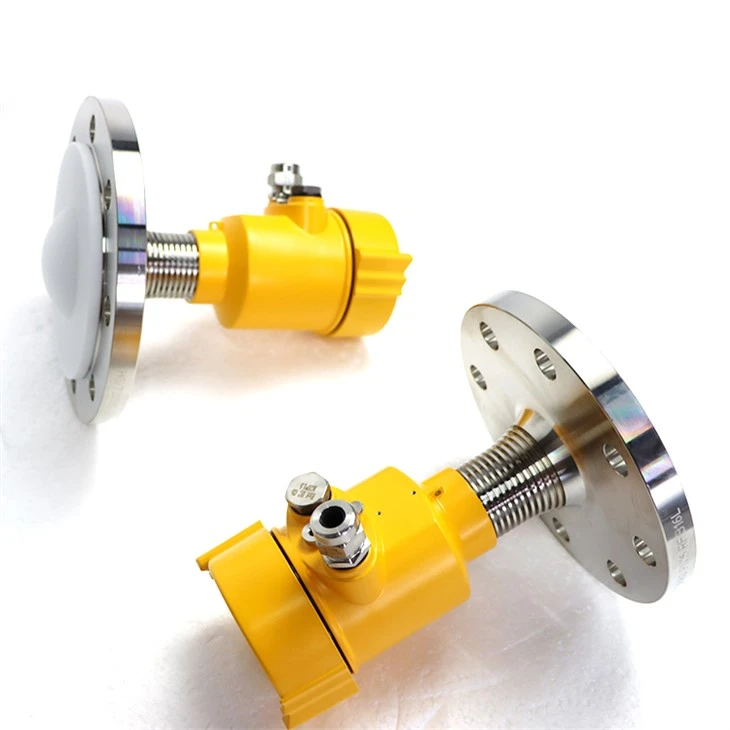
In industrial applications, such as water treatment plants and chemical manufacturing, real - time water level measurement is crucial for process control. Our DN100PN16 flange mounted radar level transmitter can provide accurate and up - to - date water level information, allowing operators to adjust the flow rates, control pumps, and ensure the smooth operation of the production process.

Scientific Research
In scientific research related to hydrology, oceanography, and environmental science, real - time water level data is invaluable. It helps researchers understand the dynamic behavior of water bodies, study the impact of climate change on water levels, and develop more accurate models for predicting future water level changes.
Limitations and Challenges
While radar water level gauges are capable of real - time measurement, there are some limitations and challenges that need to be considered:
Environmental Interference
External factors such as heavy rain, fog, and strong winds can interfere with the radar signals. Raindrops and water vapor in the air can scatter the microwave signals, leading to inaccurate measurements. However, modern radar water level gauges are designed with advanced signal processing algorithms to minimize the impact of environmental interference.
Installation Requirements
Proper installation is crucial for accurate real - time measurement. The gauge needs to be installed at the correct height and angle to ensure that the radar signals are directed towards the water surface without obstruction. Incorrect installation can result in inaccurate measurements or even the failure of the gauge to function properly.
Applications in Different Fields
Radar water level gauges are widely used in various fields where real - time water level measurement is required:
Hydrology
In hydrological monitoring, radar water level gauges are an essential tool. They are used to monitor the water levels of rivers, lakes, and groundwater. The real - time data collected by these gauges is used for flood forecasting, water resource management, and the study of water flow patterns. Our Hydrology Instruments are specifically designed to meet the demanding requirements of hydrological applications.
Coastal Monitoring
Along the coastlines, radar water level gauges are used to monitor the tides, storm surges, and sea - level changes. Real - time data on coastal water levels is crucial for coastal protection, navigation safety, and the assessment of the impact of climate change on coastal areas.
Industrial Applications
In industries such as oil and gas, chemical, and food processing, radar water level gauges are used to monitor the levels of liquids in tanks and vessels. Real - time measurement ensures the safe and efficient operation of industrial processes.
Conclusion
In conclusion, radar water level gauges are fully capable of measuring water levels in real - time. Their high - frequency sampling, continuous monitoring, and data transmission capabilities make them an ideal choice for applications where up - to - date water level information is required. Despite some limitations and challenges, the benefits of real - time measurement far outweigh the drawbacks.
If you are in need of reliable radar water level gauges for your project, whether it is for hydrology, coastal monitoring, or industrial applications, we are here to provide you with high - quality products and professional solutions. Contact us to discuss your specific requirements and start the procurement process. We look forward to working with you to ensure accurate and real - time water level measurement in your operations.
References
- "Radar Level Measurement Technology" - A technical guide on radar level measurement principles and applications.
- "Hydrological Monitoring Handbook" - A comprehensive resource on hydrological monitoring techniques, including the use of radar water level gauges.
- "Industrial Process Control and Instrumentation" - A book that covers the application of level measurement devices in industrial processes.





