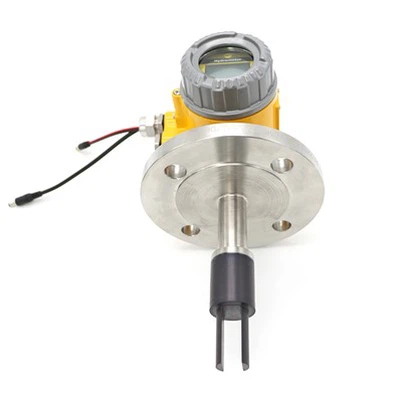

How The Tuning Fork Densiometer Works
Leave a message
Sound fork densitometer sensor is designed according to the principle of component vibration, this vibration element is similar to the sound fork of two teeth, fork body by a piezoelectric crystal located in the root of the tooth vibration, vibration frequency is detected by another piezoelectric crystal, through phase shift and amplification circuit, the fork body is stabilized at the inherent resonance frequency. When the medium flows through the fork body, the change of the resonance frequency is caused by the change of the medium mass.
Rationale: The sound fork densitometer uses the relationship between the density of a solid material and its effect on the speed of acoustic propagation.When sound waves propagate into materials with different densities, their propagation speed will change.
Vibrating sound fork: The sound fork used in the sound fork densitometer is made of a slender metal bar, shaped like an inverted "U" word.The sound fork can be vibrate by electromagnetic excitation or piezoelectric excitation.
Excitation and detection: the sound fork is excited by the electromagnetic or piezoelectric device to make it vibrate.At the same time, the built-in sensor or detector monitors the vibration state of the sound fork.
Density measurement: When the vibration wave of the sound fork propagated into the substance to be measured, the density of the substance will affect the propagation speed of the sound wave.When the sound wave spreads into the matter with different densities, its propagation speed will change, thus having an impact on the vibration of the sound fork.
Resonance frequency measurement: the density of the material is determined by measuring the resonance frequency of the sound fork.The material with higher density will decrease the propagation speed of the sound wave, which reduces the resonant frequency of the sound fork, and the propagation speed and the resonance frequency of the sound fork.
Density calculation: Based on the previous calibration and experimental data, the measured resonance frequency is compared with the corresponding density to determine the density of the material to be measured.